Open the menu at a serious restaurant and read the prices. Halibut, brown butter, 48. Tasting menu, 185. No dollar signs, no cents, nothing that ends in .99. The diner down the street prints $12.99 next to its burger.
Neither menu is careless. Both are saying something before you read a single dish. Hospitality researchers Sandra Naipaul and H. G. Parsa described the pattern in 2001: on menus, prices ending in 9 tend to say value, prices ending in 0 tend to say quality, and upscale restaurants lean toward the zero.
In 2009, a team at Cornell went one step further and tested the dollar sign itself. At a restaurant run by the Culinary Institute of America, guests whose menus showed bare numbers spent significantly more than guests whose menus showed a dollar sign or prices written out in words. It was one restaurant, at lunch, and the authors said so. But the idea stuck: the way a price is written is part of the price.
A price list on a practice website is a menu too, read in the same split second. So we wanted to know how practices write theirs. We read 9,686 prices from 273 med spa price lists.
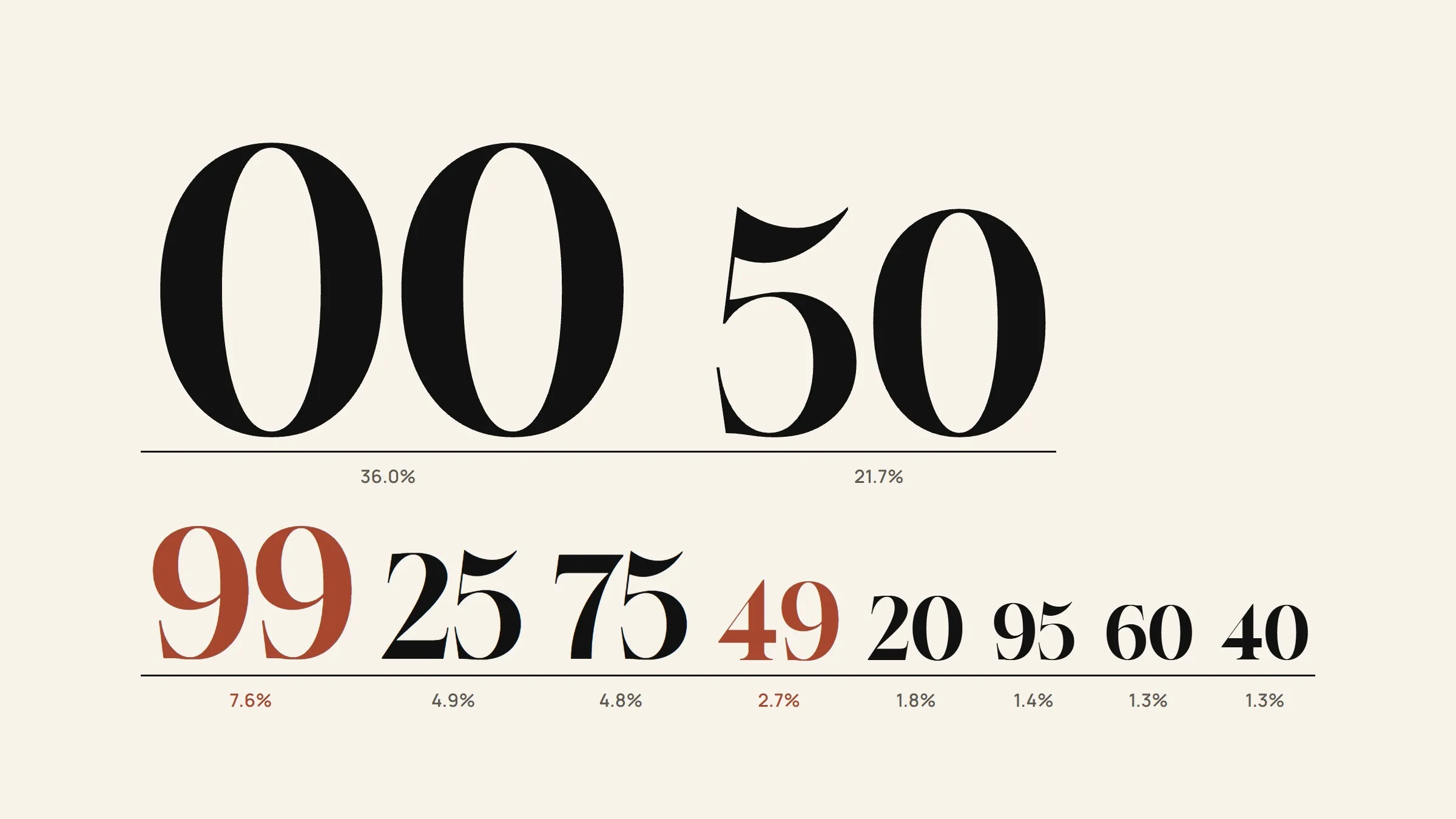
The cover of this article is part of the answer. It shows the last two digits of the 7,561 whole-dollar prices of $100 or more, each set at a size that matches how often it appears. The two biggest are 00 and 50. The ones in clay end in 9.
This article covers what research says about how people read a price, what we found on med spa price lists, and a style guide you can apply to your own price page in an afternoon.
- Only about one med spa in five publishes a price list we could read: 273 of 1,319 websites.
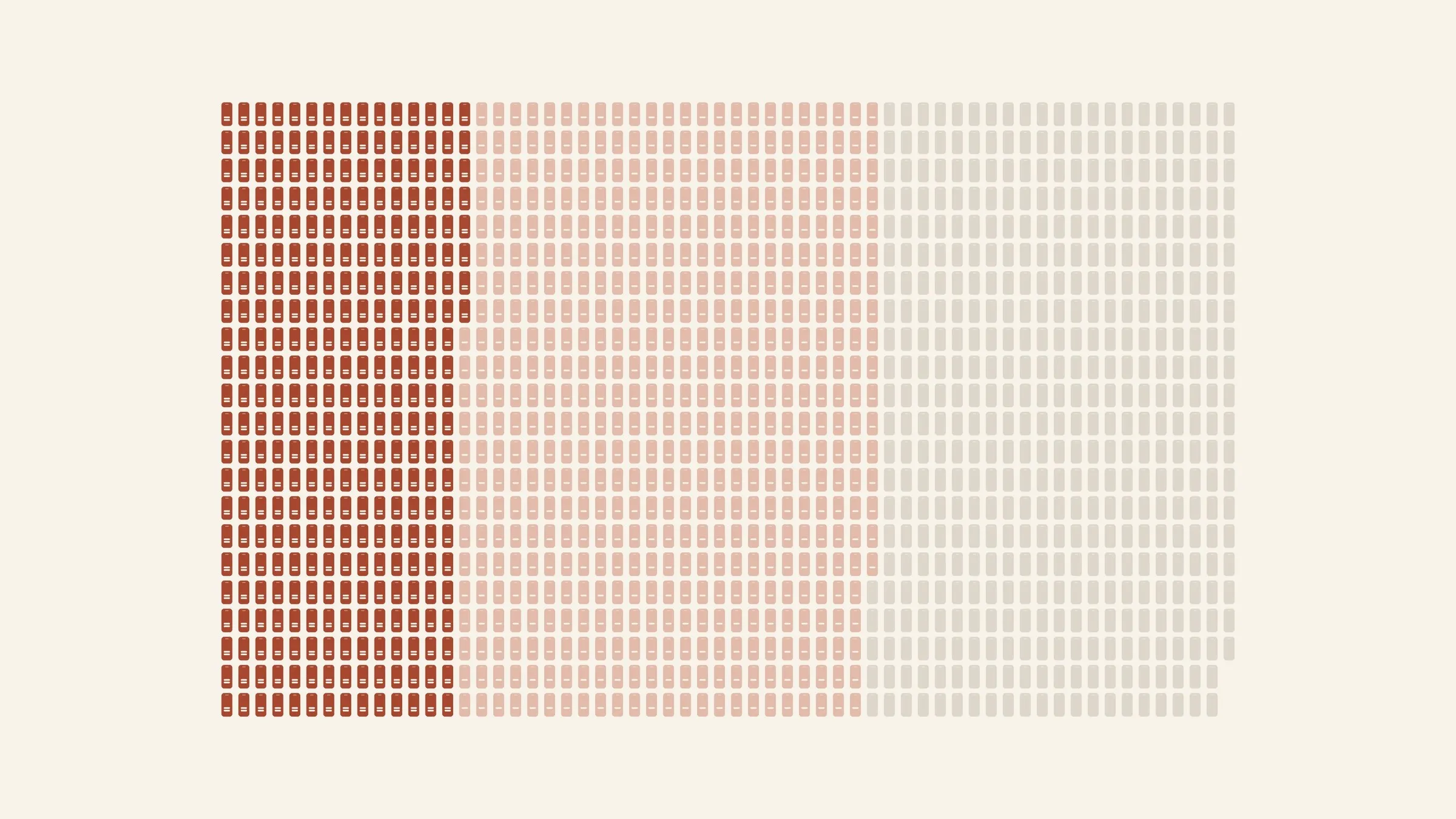
- Those that do mostly price like a good restaurant already. 60.6% of their prices end in 0, and 83.2% of prices of $1,000 or more do.
- What gives them away is everything around the number. 29.9% show cents somewhere, 22.4% write “.00”, and 22.5% of practices with four-digit prices write them two different ways.
- One practice in six mixes deal endings and quality endings heavily on the same list, so the list says two things at once.
- None of this is a trick. Format changes how big a price feels and what it signals. The goal is a fair price that reads as exactly what it is.
A price is read twice
A patient reads a price twice: once as an amount, and once as a shape. The second reading is fast, mostly unconscious, and it shifts the first.
Length. Keith Coulter, Pilsik Choi and Kent Monroe showed in 2012 that people judge a price written with a comma, or with cents, as larger than the same amount written without them. Their explanation is about sound. We silently “hear” numbers as we read them. “$1,200.00” can sound like one thousand two hundred dollars and zero cents. “1200” sounds like twelve hundred. More syllables feel like more money, even when the amount is identical.
The left digit. Manoj Thomas and Vicki Morwitz showed in 2005 why $2.99 feels like more than a cent cheaper than $3.00. People anchor on the leftmost digit, so when it changes, the price feels like it dropped a whole step. This is the engine behind every price that ends in 9.
Size. Keith and Robin Coulter found in 2005 that the physical size of the numbers matters. A price set in large type can read as a larger price, and a sale price printed smaller than the regular price looks like a better deal than the same sale price printed large. The people in their experiments didn’t notice this happening to them.
Precision. Manoj Thomas, Daniel Simon and Vrinda Kadiyali found in 2010 that precise prices are judged smaller than round prices of about the same size. People judged $395,425 to be smaller than $395,000. In real home sales, buyers paid more when the list price was precise.
None of this means patients are easily fooled. They read the amount correctly. The format simply colors the impression around it, the way the paper and type of a restaurant menu color the food before it arrives.
Round feels right, nine feels like a deal
If format shifts perception, the next question is what you want the price to say.
Monica Wadhwa and Kuangjie Zhang tested this in five studies published in 2015. Round prices “feel right” when a purchase is driven by feelings. Precise, non-round prices fit purchases driven by reasoning. In one study, the same camera drew more interest at a round price when people were buying it for a family vacation, and at a non-round price when they were buying it for a class project.
Most aesthetic treatments sit closer to the vacation than the class project. People choose them for how they want to look and feel, after a lot of careful thought, but on a feeling all the same.
Prices ending in 9 send a different message. In 2001, Robert Schindler and Thomas Kibarian found that a 99 ending made an advertised price look low and look like a discount. It also lowered the quality image of ads from higher-quality retailers.
To be fair to the nines, they do sell. Eric Anderson and Duncan Simester ran three field experiments with a mail-order clothing retailer, and prices ending in 9 raised demand in all three. The lift was biggest on new items, where customers had little else to judge by, and smaller when the price already carried a “Sale” signal. Retailers use 9 endings because they work on people hunting for value. Back in 1997, Robert Schindler and Patrick Kirby found 0, 5 and 9 at the end of advertised prices far more often than chance would put them there.
So the question isn’t whether a 9 ending sells. It’s whether “value” is what you want a patient to feel about the person holding the syringe.
How we read 273 price lists
We started from the 1,319 med spa websites in our phone study, read in November 2026 across 45 states. On November 23, 2026, we went back for their prices. We read every pricing page their homepages linked to, plus any pricing page listed in their sitemaps: 248 pages from 224 practices, one plain read each. We read again, in a full browser, the 74 pages that showed few or no prices on the first read, in case prices loaded late. It changed the result for one practice. We added the prices already captured from each homepage.
Then we counted every dollar amount and removed what isn’t a price for something: discounts, credits, deposits, fees, gift cards and order minimums. We set per-unit and monthly membership prices aside, because they follow their own logic. A practice counts as having a price list if we found at least three prices.
Software did the counting, so we checked it by hand. Of 80 prices drawn at random, 79 were real prices for a treatment, product, package or service. The one miss was a gift card amount, and we tightened the filter after it.
Finding 1: Four in five practices don’t show a price list
Only 20.7% of practices had a price list we could read (273 of 1,319). Our phone study counted 17.9% with a stricter, homepage-only test. Either way, about four in five practices give a patient no price to hold on to.
Some of the missing lists probably exist as pictures: a scanned menu, a JPG, a PDF. We couldn’t read those, and neither can a screen reader. Search engines and AI assistants often miss them too. We return to this in the style guide.
Finding 2: Most prices already end in zero
Per-unit and monthly prices set aside. 95% intervals resample whole practices, because prices on the same list tend to look alike: 0 endings 56.6 to 64.6; 5 endings 17.9 to 22.3; 9 endings 9.1 to 15.4; other 5.2 to 9.3.
This was the surprise. Med spas don’t price like a discount store. Six prices in ten end in zero. Among prices of $100 or more, the most common last two digits are 00 (36.0%) and 50 (21.7%). Only 7.6% end in 99.
The bigger the price, the rounder it gets:
Ends in 0Ends in 9
- Under $100 (2,049 prices)Ends in 0: 38.4%Ends in 9: 8.4%
- $100 to $999 (5,827 prices)Ends in 0: 61.3%Ends in 9: 14.9%
- $1,000 or more (1,810 prices)Ends in 0: 83.2%Ends in 9: 7.2%
95% intervals, resampling whole practices. Ends in 0: 34.1 to 42.8; 56.9 to 65.6; 78.1 to 87.9. Ends in 9: 5.9 to 11.6; 11.2 to 19.0; 3.9 to 11.3. Under $100, prices ending in 5 are almost as common as those ending in 0 (35.4%).
Notice where the nines cluster: between $100 and $999, where single facials, peels and laser sessions live. That is where a price list most often starts to look like a retail shelf, with a $199 facial next to a $450 laser session.
The instinct behind the round numbers is right. Practices seem to sense what restaurants know. The trouble starts around the number.
Finding 3: One list, two messages
Looking at each practice as a whole, 56.7% write most of their prices with a round ending, and only 10.6% use mostly 9 endings. But 53.1% use at least one price ending in 9 somewhere, and 16.9% mix the two heavily, with at least a fifth of their prices ending in 0 and at least a fifth ending in 9.
A mixed list sends two messages at once. A $450 laser session says quality. The $199 facial printed above it says deal. A patient reading both can’t tell which practice they’re looking at.
Finding 4: The details around the number
Per-unit and “starting at” out of 273 price lists; cents, “.00” and endings out of the 254 lists with three or more regular prices; four-digit prices out of the 138 lists with a price of $1,000 or more. 95% intervals: 35.4 to 46.9; 27.0 to 38.0; 24.6 to 35.8; 16.3 to 30.1; 17.7 to 28.0; 12.8 to 22.0.
Cents. 29.9% of practices show cents somewhere, and 18.1% show them on most of their prices. Usually it is “.00”, which adds length and syllables and no information. Nobody pays $650.00 for a peel and expects change.
Thousands. 36.8% of prices of $1,000 or more are written without a comma, like $1200. That is a legitimate style. But half of the practices with four-digit prices use it at least once, and 22.5% use both styles on the same list: $1,200 in one line, $1800 in the next. To a reader it looks like two people typed the list, which is often exactly what happened.
“Starting at.” 32.2% of practices use “starting at” or “from” at least once, and 24.5% give ranges like $500 to $800. Both are honest tools when the price really varies. They need a real number a patient can actually book, and a word on what that number buys.
Units. 41.0% list a per-unit price for neuromodulators. The most common are $12 and $13 a unit. A per-unit price is precise by nature, and that’s fine. It reads as a rate, the way a price per pound does, rather than as a statement about the practice.
The bigger problem is no price at all
Endings and commas matter only if a price exists. For four practices in five, it doesn’t.
Information foraging theory, developed by Peter Pirolli and Stuart Card at Xerox PARC, describes people online as foragers following a scent. They keep moving while the cues suggest they are getting closer to what they want. When the scent goes cold, they leave and try somewhere else. For a patient comparing practices, the strongest scent on a treatment page is a price. Without one, the next step is the back button, and a search for someone who shows theirs.
Plastic surgery offers some direct evidence, with a caveat. In a 2024 survey in Plastic and Reconstructive Surgery Global Open, Parul Rai, Jonathan Kaplan and colleagues found that most providers did not share their prices online. Patients who had received an online estimate before their consultation reported a good experience, and most said their final cost was close to or below the estimate. The authors call price transparency a patient satisfier. Kaplan has also reported that consumers who saw prices through his platform were 41% more likely to book. He founded that platform, so read both with that in mind.
A practice doesn’t need to publish every price. One real starting price per treatment, with what it includes, does most of the work. The hesitation we hear most often is that published prices invite price shoppers. Maybe. But a patient who can’t find a price doesn’t stop shopping. They shop somewhere else.
When round is wrong
Round isn’t a law. Three cases where it isn’t the right call:
- Rates. Per-unit, per-syringe and per-session prices are rates, and precise rates read as calculated rather than cheap. Keep them as they are, and say the unit.
- Real promotions. A 9 ending says “deal”, and sometimes a deal is the point. Keep promotions in their own section with an end date, so the main list keeps its own voice.
- Large quotes. The house-price study suggests that a precise figure can feel smaller and more considered than a round one. For a surgical quote built from real line items, an exact total can be more honest than a rounded one.
What matters is that each style is a decision, used for one kind of price, and not an accident of who typed which line.
A style guide for your price page
Here is the difference in practice. The prices are examples, not real practices.
| Written like a sale rack | Written like a menu |
|---|---|
| Signature facial $199.00 | Signature facial, 60 minutes · $200 |
| Laser, full face $1,200 and laser, full face and neck $1800 | $1,200 and $1,800, one style for every four-digit price |
| Botox $13 | Botox · $13 per unit |
| Microneedling starting at $99* | Microneedling, full face, one session · from $350 |
| A large, bold $ in the accent color | A $ the same size and weight as the number |
| Price list saved as a JPG | Price list written as text on the page |
And the rules behind it:
- Decide what your prices should say.Round endings for treatments and packages. Save 9 endings for real promotions, in their own section. One list, one voice.
- Drop the cents.“.00” adds length and syllables and no information. If every price is in whole dollars, write whole dollars.
- Pick one way to write thousands.The comma makes a price read slightly larger, so either style can be defended. Both on one page can’t.
- Keep the dollar sign quiet.Same size, weight and color as the number, or a touch smaller. Never bigger, bolder or brighter. The menu evidence comes from one restaurant, but there’s no reason to make the currency the loudest thing on the line.
- Let the treatment lead, not the price.Set prices in the body font, at body size, with digits that line up in a column. A price in giant type reads as a bigger price.
- Say what the price buys.Per unit, per syringe, per area, per session, how many minutes. A number with no unit makes the patient guess, and guesses run high.
- Use “from” only for a price a patient can book.The starting price should be real and available, with what it covers. If you show a “regular” price next to a sale price, it has to be a price you genuinely offered for a reasonable stretch of time. The FTC’s guides on former-price comparisons say so.
- Write prices as text, not pictures.A price list saved as an image or PDF can’t be read by a screen reader, is easy for search engines and AI assistants to miss, and doesn’t zoom cleanly on a phone. WCAG asks for real text wherever text can do the job.
- Write each price the same way everywhere.Website, booking software, Instagram, ads. Patients compare, and a price that changes shape between screens looks like a price that changes.
If you can only do one thing this week, do the last one on your own price page: read it from top to bottom out loud. Every place where you stumble over a “.00”, a missing comma or a $199 next to a $450 is a place where your patient stumbles too.
What this can and can’t tell you
- We measured how prices are written, not what patients do. We have no booking data. The link between format and perception comes from outside research, mostly in retail, restaurants and real estate, not in medicine.
- Some of that research is mixed. The quality-image effect of 9 endings hasn’t held up equally in every study, and economists still debate why sellers round their prices. The Cornell menu result comes from one restaurant at lunch.
- Plain reads miss some prices. Prices drawn by scripts after the page loads, and prices shown as images or PDFs, are invisible to a plain read. We re-read pages with few prices in a full browser, which changed one result, but price lists published as pictures still count as no list.
- Long lists weigh more in per-price figures. A practice with 80 prices counts 80 times in the endings chart. That’s why we also report the practice-level figures, and why the intervals resample whole practices.
- The sample is the same as our phone study, which leans toward well-reviewed independent practices in mostly affluent towns.
Set the table
A good restaurant menu doesn’t hide its prices, and it doesn’t shout them. It writes them so the food stays the main event. Most practices that publish prices are already halfway there: their numbers are round. What’s left is small and typographic, an afternoon of work. The cents go, one comma rule stays, the deal prices move to their own section, and every price says what it buys.
The harder half is deciding to show a price at all. Four practices in five haven’t yet.
The method behind the sample is in the full phone study. A price page is one of the things we look at in every website review, and you can ask us to look at yours.
Sources
- STRIXA STUDIO, How US med spas show up on a phone, 2026. The sample of 1,319 websites comes from this study. The price figures in this article come from a second read of their price pages on 23 November 2026.
- S. Naipaul and H. G. Parsa, Menu price endings that communicate value and quality, Cornell Hotel and Restaurant Administration Quarterly 42(1), 2001.
- S. S. Yang, S. E. Kimes and M. M. Sessarego, $ or dollars: Effects of menu-price formats on restaurant checks, Cornell Hospitality Report, Cornell University, 2009, and Cornell Chronicle coverage.
- K. S. Coulter, P. Choi and K. B. Monroe, Comma N’ cents in pricing: The effects of auditory representation encoding on price magnitude perceptions, Journal of Consumer Psychology 22(3), 2012.
- M. Thomas and V. Morwitz, Penny wise and pound foolish: The left-digit effect in price cognition, Journal of Consumer Research 32(1), 2005.
- K. S. Coulter and R. A. Coulter, Size does matter: The effects of magnitude representation congruency on price perceptions and purchase likelihood, Journal of Consumer Psychology 15(1), 2005.
- M. Thomas, D. H. Simon and V. Kadiyali, The price precision effect: Evidence from laboratory and market data, Marketing Science 29(1), 2010.
- M. Wadhwa and K. Zhang, This number just feels right: The impact of roundedness of price numbers on product evaluations, Journal of Consumer Research 41(5), 2015.
- R. M. Schindler and T. M. Kibarian, Image communicated by the use of 99 endings in advertised prices, Journal of Advertising 30(4), 2001.
- E. T. Anderson and D. I. Simester, Effects of $9 price endings on retail sales: Evidence from field experiments, Quantitative Marketing and Economics 1, 2003.
- R. M. Schindler and P. N. Kirby, Patterns of rightmost digits used in advertised prices: Implications for nine-ending effects, Journal of Consumer Research 24(2), 1997.
- P. Pirolli and S. Card, Information foraging, Psychological Review 106(4), 1999.
- P. Rai, P. Pareek, C. L. Vilas and J. L. Kaplan, The controversy over price transparency: Patients and plastic surgeons disagree, Plastic and Reconstructive Surgery Global Open 12(10), 2024.
- Becker’s ASC Review, Dr. Jonathan Kaplan focuses on the importance of price transparency.
- M. Stiving, Price-endings when prices signal quality, Management Science 46(12), 2000, and the 2003 comment by R. Shoemaker and colleagues.
- Federal Trade Commission, Guides Against Deceptive Pricing, 16 CFR Part 233, including 233.1 on former price comparisons.
- W3C, Web Content Accessibility Guidelines 2.2, Images of Text.
By STRIXA STUDIO. This article is general information, not legal or medical advice. Rules for advertising and patient information vary by state and platform, so check with your attorney.